
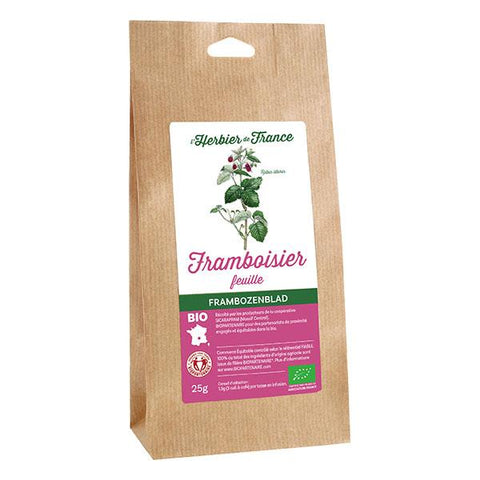
Organic Raspberry Leaves -25g-Herbier de France
Remaining stock : 0
 24/48h shipping
 Home delivery or delivery to relay points from €4.30, free from €60
 100% compensated Green delivery
Organic Raspberry Leaf Herbal Tea: Women's Comfort, Menstrual Pain, and Preparation for Childbirth
Are you suffering from menstrual pain, uterine cramps, or are you in late pregnancy and looking for a medicinal plant traditionally used for centuries for women's comfort, natural hormonal balance, and preparing the uterus for childbirth? Organic Raspberry Leaves (Rubus idaeus) are one of the most iconic plants in European women's herbal medicine. Rich in fragarine (a specific uterine spasmolytic alkaloid), tannins, flavonoids, and vitamins C and E, they are used in well-established traditional practice to relieve menstrual pain, strengthen uterine tone, and prepare the uterus for childbirth. 25g of organic leaves. Certified Organic Agriculture.
The benefits of organic raspberry leaves
- The reference feminine plant in European herbal medicine: raspberry leaves have been used for centuries in all European midwifery traditions for menstrual comfort and preparation for childbirth. Even today, they remain one of the plants most widely used by midwives and pregnant women in England and Northern Europe.
- Fragarine: the uterine tonic alkaloid: fragarine is an alkaloid specific to raspberry leaves that is believed to exert a toning action on the smooth muscles of the uterus. It regulates uterine contractions, which explains its action on dysmenorrhea as well as its traditional role in preparing for childbirth.
- Relief of menstrual pain: tannins and fragarine reduce painful uterine spasms during menstruation. Raspberry leaves are a natural alternative to painkillers for mild to moderate dysmenorrhea.
- Rich in vitamins C and E and minerals: iron, calcium, magnesium, potassium, and manganese in significant concentrations for women of childbearing age and pregnant women.
- Can be drunk hot or cold: pleasant, slightly tannic flavor that is just as good as a hot herbal tea or a cold summer drink.
Active ingredients and their traditional role
Fragarine
Fragarine is an alkaloid present in raspberry leaves that exerts a toning and regulating effect on the smooth muscles of the uterus. It reduces painful spasmodic uterine contractions while maintaining the overall tone of the uterus. Its mechanism combines a spasmolytic action on excessive contractions with a toning action on physiological contractions, which explains its traditional use both for dysmenorrhea and for preparation for childbirth. These properties are based on traditional use.
Gallic and ellagic tannins
The tannins in raspberry leaves contribute to the plant's astringent and anti-inflammatory action on mucous membranes. They reduce excessive bleeding during periods (mild hemostatic action) and contribute to pelvic anti-inflammatory action.
Flavonoids (quercetin, kaempferol)
The flavonoids in raspberry leaves have antioxidant, anti-inflammatory, and spasmolytic properties that complement the action of fragarine. Quercetin is particularly studied for its anti-inflammatory properties and its influence on female sex hormones.
Vitamins and minerals
Raspberry leaves are an interesting source of vitamin C, vitamin E, iron, calcium, and magnesium. These nutrients are particularly relevant for women of childbearing age and pregnant women in their third trimester.
Who is this herbal tea for?
- Women suffering from dysmenorrhea (menstrual pain) looking for natural spasmolytic support
- Pregnant women in their third trimester (from the 32nd week onwards) wishing to prepare the uterus for childbirth with the advice of their midwife
- Women suffering from irregular periods or premenstrual syndrome looking for natural regulation
- Women wanting a foundational feminine herbal tea rich in natural vitamins and minerals
Composition
| Plant | Part used | Origin | Certification |
|---|---|---|---|
| Raspberry (Rubus idaeus) | Dried leaves | Europe | Organic Agriculture |
25g. 100% organic raspberry leaves. No additives or preservatives. Traditional use. Does not replace the advice of a medical professional or midwife.
How to prepare this herbal tea?
Pour 2 teaspoons of dried leaves (2 to 3g) into a cup. Cover with boiling water (200ml). Let it infuse covered for 5 to 10 minutes depending on your taste. Strain. Drink 1 to 3 cups per day. For menstrual pain, start 3 to 5 days before your period and continue for the first few days. For use in late pregnancy, consult your midwife's advice. Delicious as a cold infusion with a little lemon in summer.
Important precautions
- During pregnancy: use exclusively in the third trimester (from 32 weeks) and with the approval of your midwife or doctor. Raspberry leaves are contraindicated in early and mid-pregnancy.
- Not recommended in cases of history of cesarean section or premature labor
- Not recommended in cases of uterine pathology (fibroids, severe endometriosis) without medical advice
- Do not confuse with strawberry leaves or raspberry berries, which have different properties
- Keep out of reach of children
FAQ
Do raspberry leaves induce labor?
No, raspberry leaves do not induce labor. They tone and regulate uterine contractions, making labor more coordinated and potentially shorter according to some clinical studies. They do not cause contractions in a woman whose uterus is not ready. This is why their use is recommended only from 32-36 weeks of pregnancy.
Can raspberry leaves be used during painful periods?
Yes, it is a classic indication. Fragarine and tannins reduce painful uterine spasms. For an optimal effect, start drinking 2 to 3 cups per day 3 to 5 days before your expected period and continue for the first 2 days. Many women report a significant reduction in cramps.
Are raspberry leaves found in all pharmacies?
No, they are mainly available in herbal shops and organic stores. High-quality organic leaves are more concentrated in active ingredients than many industrial sachets.
The quintessential European feminine plant, from menstrual comfort to preparation for childbirth, in quality organic leaves
Organic raspberry leaves (Rubus idaeus), rich in fragarine, tannins, and vitamins, 25g.
Discover the Herbier de France range
Read our article: The best plants against fatigue
Order on pleine-forme.net
We clean up after ourselves.
Ecommerce deliveries have a carbon footprint. That's why we support verified projects that remove carbon from the air.


Every delivery’s carbon footprint is calculated based on weight, shipping method, and distance traveled. We neutralize these emissions by purchasing verified carbon removal credits from groundbreaking projects.


With your purchase, you’ll join a community of proactive merchants and customers dedicated to a sustainable future. Together, we've removed emissions for over 87 million deliveries and removed over 60 thousand tonnes of carbon.
We work with a network of pioneering carbon removal companies that have been vetted by the commerce platform Shopify.

