
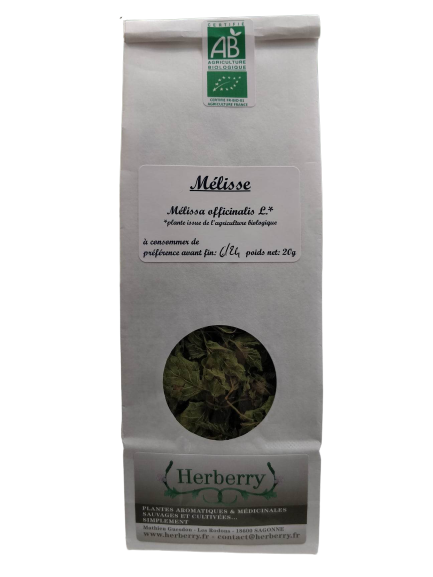
Lemon balm leaves for infusion-20g-Herberry
Remaining stock : 10


 24/48h shipping
 Home delivery or delivery to relay points from €4.30, free from €60
 100% compensated Green delivery
Organic Lemon Balm Leaves for Herbal Tea — A Lemon-Scented Plant from the European Herbalist Tradition
Lemon balm (Melissa officinalis), also known as balm mint or bee balm, is a perennial plant in the Lamiaceae family that is widely cultivated throughout Europe. Its leaves, with their characteristic lemon scent, make it one of the most popular herbal teas in family herbalism. Herberry offers certified organic dried lemon balm leaves.
Botanical Description
Melissa officinalis is a perennial herbaceous plant that can reach 40 to 80 cm. Its oval, slightly serrated, and wrinkled leaves are a bright green and immediately release a very characteristic lemon aroma when crushed. The small, whitish flowers appear from June to August and attract bees — hence the Greek name melissa (bee). The plant is very easy to grow and can be invasive in gardens.
The leaves contain an essential oil rich in citral (geranial and neral), citronellal, and linalool, as well as phenolic acids (significant amounts of rosmarinic acid, caffeic acid), flavonoids, and triterpenes.
Aroma and Flavor Profile
Lemon balm infusion creates a liqueur that is slightly golden to greenish, depending on the concentration. Its aroma is lively, lemony, fresh, and pleasant. On the palate, the flavor is mild, lemony, and slightly herbaceous, with very little bitterness. It is one of the easiest herbal teas to enjoy, even for those not accustomed to herbal infusions. It pairs perfectly with verbena, lavender, or chamomile.
How to Prepare the Infusion
- Quantity: 1 to 2 teaspoons of dried leaves (about 1.5 to 2 g) per cup
- Water: simmering, about 90°C (do not boil, to preserve the volatile aromas)
- Infusion: 5 to 8 minutes, covered
- Strain and enjoy lukewarm
- Frequency: 2 to 3 cups per day
Composition
| Ingredient | Detail |
|---|---|
| Lemon balm (Melissa officinalis) | Dried leaves |
| Certification | Certified organic farming |
| Packaging | Resealable kraft pouch 20 g |
| Origin | Europe |
Precautions for Use
- Not recommended for people suffering from thyroid disorders (hypothyroidism, Hashimoto's disease) without medical advice — lemon balm may interfere with thyroid hormones
- Not recommended for pregnant or breastfeeding women without medical advice
- Not recommended for children under 6 years old
- If you are taking sedative or thyroid medication, consult a doctor before consumption
- Do not exceed the recommended amounts
- Dietary supplements are not a substitute for a varied and balanced diet
FAQ
Is Herberry's organic lemon balm certified?
Yes, these lemon balm leaves are certified organic, free from pesticides or synthetic chemical inputs.
What is the difference between lemon balm and lemon verbena?
Lemon balm (Melissa officinalis, Lamiaceae family) and lemon verbena (Aloysia citrodora, Verbenaceae family) are two distinct plants with a similar lemon scent. Verbena is often more intense and refined; lemon balm is more herbaceous and slightly mentholated. Their phytochemical compositions differ.
Can fresh lemon balm be used instead of dried lemon balm?
Yes, fresh lemon balm from the garden can be used in an infusion (double the amount compared to dried). Dried lemon balm, however, is more practical and stores better. Note that drying may slightly change the aroma profile.
How should I store my bag of lemon balm?
Keep away from direct light, heat, and humidity. Close the bag tightly after use to preserve the volatile lemon aromas. Consume preferably within 12 months.
Discover other Herberry herbal teas: See the full Herberry range
We clean up after ourselves.
Ecommerce deliveries have a carbon footprint. That's why we support verified projects that remove carbon from the air.


Every delivery’s carbon footprint is calculated based on weight, shipping method, and distance traveled. We neutralize these emissions by purchasing verified carbon removal credits from groundbreaking projects.


With your purchase, you’ll join a community of proactive merchants and customers dedicated to a sustainable future. Together, we've removed emissions for over 87 million deliveries and removed over 60 thousand tonnes of carbon.
We work with a network of pioneering carbon removal companies that have been vetted by the commerce platform Shopify.

